AWARE: challans people can trust
How I designed a traffic challan a driver can verify, find and close, on top of systems India already runs.
Read the detailed case studyTotal challans
Pending
Disposal rate
Pending amount
Dashboard-reported figures from the Official e-Challan Report (MoRTH), not independently audited. The dashboard is dynamic. Separately, CARS24 estimates that about 75% of the ₹12,000 cr in fines issued in 2024 went unpaid (May 2025).
The system works. Until it reaches the driver.
India can issue a traffic challan in seconds.
A camera reads the plate. VAHAN finds the owner. The challan is generated. Nobody has to lift a finger.
Then it has to reach a person.
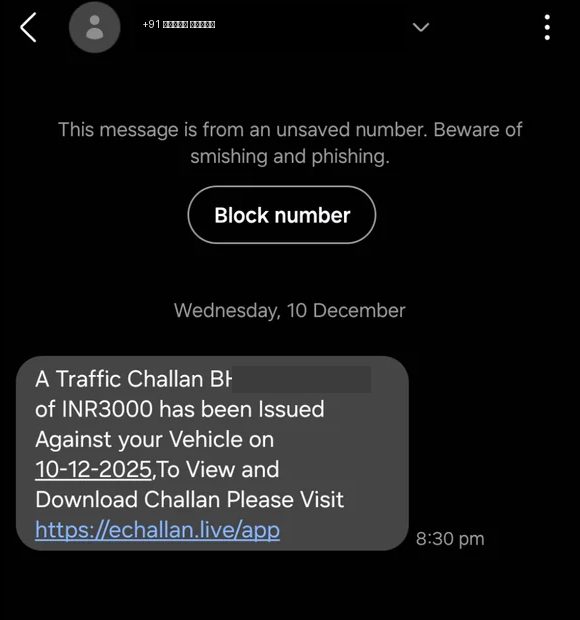
An SMS from an unknown number. A bare link. No photo, no place, nothing to check.
In an inbox full of scams, the careful thing to do is ignore it.
So the challan sits. Unseen, untrusted, or paid with no proof that it worked.
(This was the problem.)
01What drivers expect
Imagine getting a bank alert you weren't expecting. You don't tap the link. You open the app you already trust.
Drivers treat challans the same way.
In my interviews, 8 of 12 drivers said they distrusted the challan SMS or put off acting on it. Reported
They weren't careless. They were being careful.
The same four patterns kept coming up. These are synthesised patterns, not individual participants:
Ignores the SMS and finds out at a police stop.
Pays, then can't tell if it worked.
Checks only the home-state portal.
Wants to see the evidence before believing it.
02The problem
Every step after the challan is generated asks the driver to guess. Is the message real? Which state's portal holds it? Did the payment go through? How do I say it's wrong?
In 6 think-aloud sessions, participants needed 4.2 portal visits on average just to find their challan. Reported Records are split by state, payments aren't confirmed, and disputing meant going to a police station.
How much this explains national non-payment wasn't measured. I treat that link as a hypothesis.
How might a driver know a challan is real, theirs, and closed?
03Designing for proof, not alarm
The obvious fix is a louder notice. That's the wrong fix. A louder notice just looks more like a scam.
The research pointed to three principles instead:
Distrust is rational. The notice has to prove itself before it asks for anything.
Drivers can't judge a challan they can't see. The photo comes before the fine.
The low point wasn't getting the challan. It was paying and not knowing whether it worked.
From 12 interviews, 6 think-alouds, 3 intersections, police and RTO interviews, and 9 benchmarked systems. All qualitative.
04Four directions
Each concept started from a different break in the journey.
| Concept | Optimises for | Breaks when | Score |
|---|---|---|---|
| ChallaNSafe | A notice you can trust, plus one search | The phone number is out of date | 4.2 |
| ChallanBoard | Live status for every challan | Sceptics never sign up | 3.6 |
| ChallaNAid | A clear next step | The challan hasn't been found yet | 2.8 |
| Smart City LCD | Reaching drivers without a smartphone | Privacy is handled carelessly | 2.8 |
Designer-led Unweighted mean of my own 1–5 ratings. Not user-validated.
I chose ChallaNSafe as the core, because distrust and non-discovery come first. ChallaNAid's dispute flow became the "act" step. The Smart City LCD stayed exploratory: it can reach drivers whose phone number is out of date, but it carries the most risk.
05One journey, five questions
AWARE is a layer over the systems that already hold challan data, not a new portal. Each screen answers one question, in the order a careful driver asks them.
One search across states, showing how fresh the data is.
A case number the driver can check outside the notice.
The photo first, zoomed to the plate. Dispute is as big as Pay.
Every state, including failure, covers both the money and the legal position.
Closure is pushed to the driver, so they never need to check a portal.
Not tested HTML mock-ups built from the written specification, using sample data. Scroll sideways →
The hardest decision was what not to say. A screen can only say "your account has not been charged" once the payment gateway has confirmed it. Until then, the honest state is "Processing". Untested
The same goes for search: a blank result on stale data is a lie. So every result shows when that state's records were last updated.
06Taking it to the roadside
The phone flow still assumes the notice reaches the right phone. For drivers whose number on record is old, it never will.
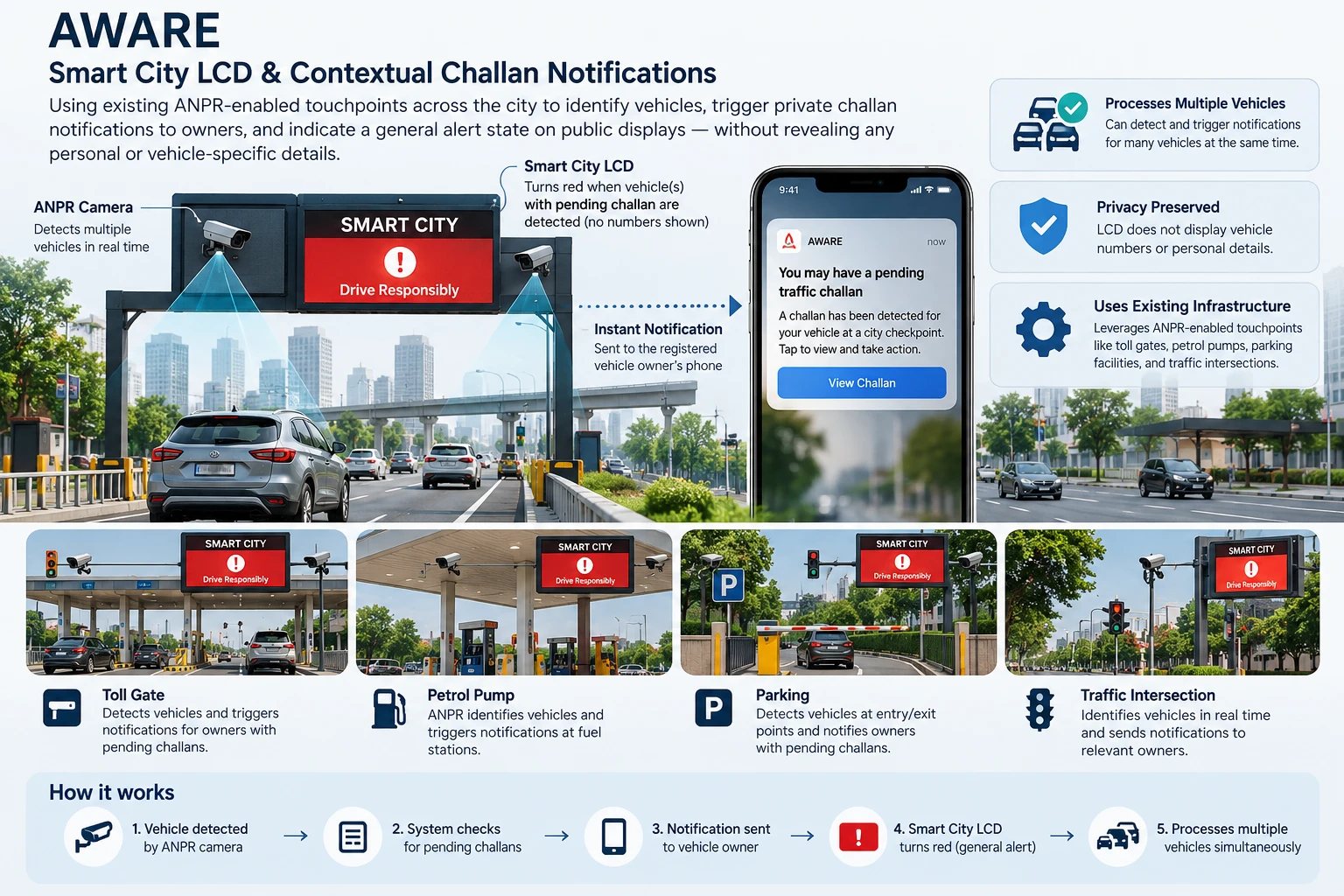
So I looked at the places drivers already stop: toll gates, petrol pumps, parking, and traffic intersections. Many already have ANPR cameras. Proposed
When a vehicle with a pending challan is detected, its owner gets a private notification to verify and act on. The Smart City LCD only turns red, as a general system-status indicator. It never shows the registration number, the owner's identity or the challan details.
And unlike a display that handles one car at a time, the system could process several detections at once and notify each owner as they pass.
07An edge case that changed the design
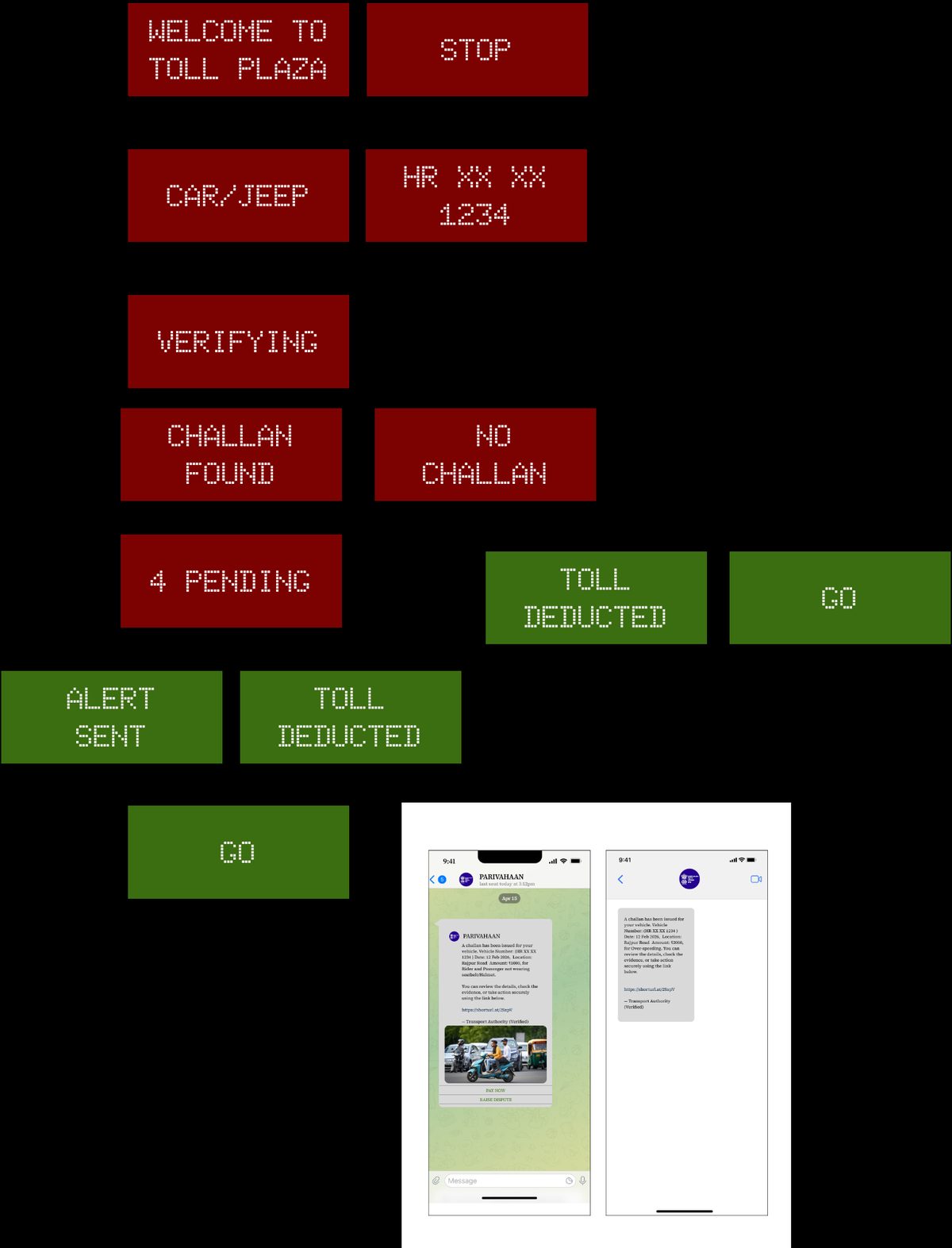
My first toll display showed everything at once: stop, vehicle class, plate, verifying, challan found, 4 pending, toll deducted, alert sent, GO.
I tested it with 4 participants across toll, pump and parking scenarios. They found the messages ambiguous, saw no next step, and felt overloaded. Reported
Version 2 showed one state at a time:
Then the edge-case review turned up two problems. A driver could read GO as "no challan". And version 2 still put the amount on a public screen, which breaks my own privacy rule.
That's why the Smart City LCD in chapter 06 shows only a general red alert, and sends everything else to the phone. Not yet tested
08What's proven, and what isn't
I built a lab prototype. A webcam reads a plate, a script looks it up in a mock spreadsheet of challans, and an SMS goes out through a Twilio trial account.
It misread a plate, and I corrected it by hand. That's exactly the misread officers had described, and it's why the evidence photo comes first.
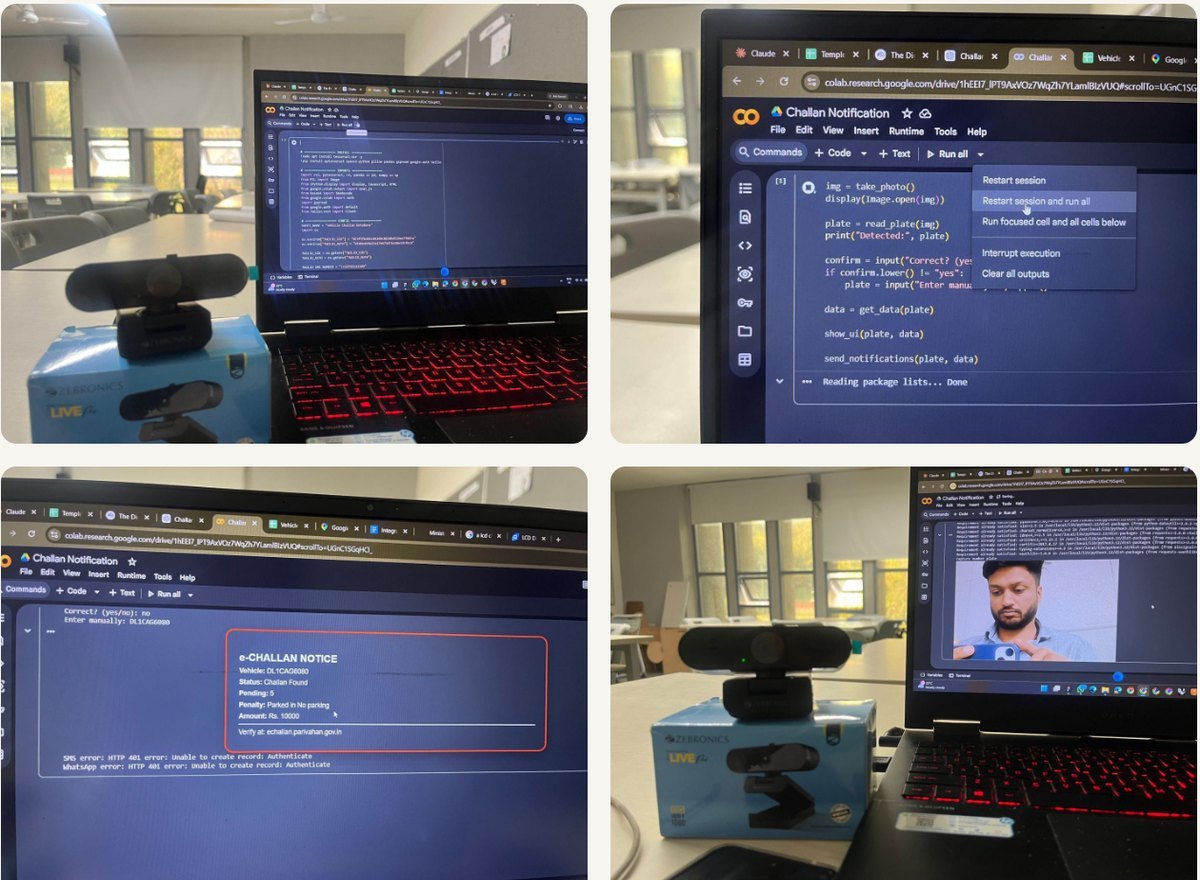
Plate read → mock database → SMS. No official data or channels.
The toll display only. Nothing was measured.
The mobile journey, cross-state search, reconciliation and disputes.
State data agreements; real misread rates; a DPDP review (a plate-only search would expose other people's challans); dispute-desk staffing.
Where it stands
AWARE hasn't shipped. It's a concept with a working lab prototype and one tested iteration.
But it changed how I think about civic design.
Most enforcement design focuses on the moment a violation is caught. For the driver, the moment that matters comes later: when a message arrives and they have to decide whether to believe it.
If people can check what they're told, acting on a challan stops being a gamble. That's the bet AWARE makes, and it's the bet I want to test next.
Next: real, fake and AWARE notices, tested with 6–8 drivers
- Official e-Challan Report (national dashboard), MoRTH. Dashboard-reported snapshot; figures change over time.
- CARS24 Challan Report (May 2025), via Business Today, 19 May 2025. Company estimate.
- Primary research, Jan–May 2026, as reported in the project report.